Tuesday, 30 April 2013

Adapting Fmp into objects

The most obvious part of my book to adapt is my main character. Now I have my character designs finished I can begin to think of ways to adapt the collages I have made of her into interactive objects to promote my book.

I will start simple, by making card dolls that stand up on their own, and then develop these experiments to make games that a child could interact with, and possibly find a way to make dolls with moveable parts. 

I can also use other aspects of my book, such as scenery and objects that appear throughout the book. For example, there is a ginger cat that appears in the background of many of the pages, so I could experiment with that too. 

At this point in the project I can really link my experiments to my FMP as my character designs and ideas have been finished. 


Mix and Match Card Game

I wanted to create a card game to go alongside my book. I was inspired by looking at flip books for children where you can mix and match animal body parts to create new creatures, such as this one by Jen Skelley (http://www.jenskelley.com)


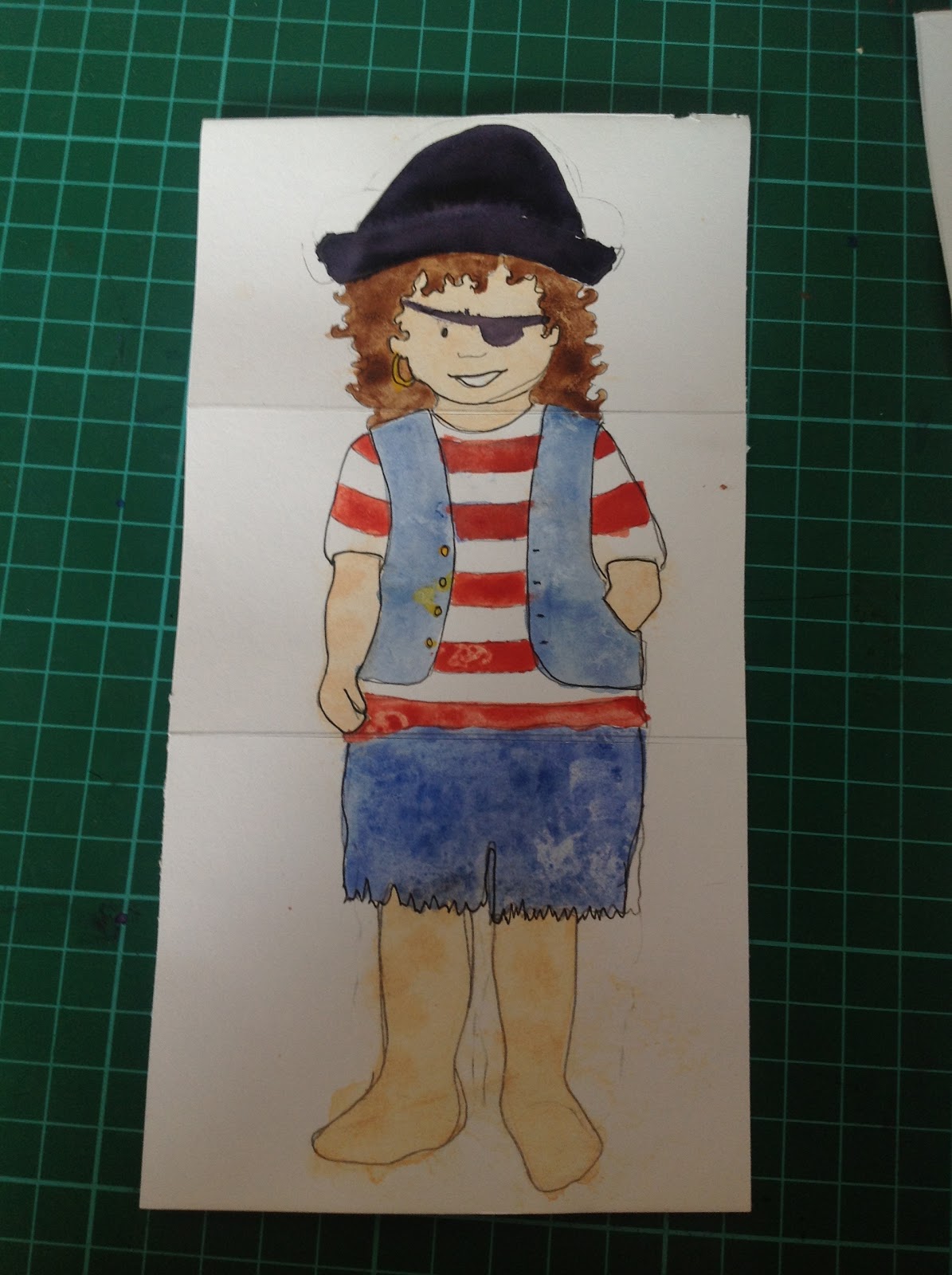
I wanted to link this with my book, and so I see how this idea would translate into a character with different outfits. I drew a basic template of my character so that I could make sure each design matched up at the edges where I wanted to cut - between the neck and shoulders, and just below the arms - so that when put together no matter what combination you used it would still look seamless.

I made eight designs in total, which fit onto two pages that can easily be printed and sold. I tried to vary the designs between fancy dress to match the theme of my book and regular outfits a child would wear, such as a winter coat and scarf, or a pair of pyjamas.


Once I had the designs I printed them off and cut them. I think in the future I need to add a dotted line where they need to be cut to make it easier for people to cut themselves, and perhaps print each design on individual pieces of paper so that they have more space around the edge of each one.


They look really nice together as a set, and in the future I can expand on these and add other outfits to make separate sets that people could purchase. I would need to make sure that any future designs I made were the same size as these and fitted together with them so that people could use them all together, which would make them more collectable and make people more likely to buy multiple sets. 
I could also design a set using a different character. Or perhaps make a character with different facial features and hair, but make sure their body proportions and posture matches this set so that they could be interchangeable if you purchased both sets.


When assembled together the images match up completely lengthways, however because they are on different widths of paper the edges of the paper do not match up which is something I will need to change. 
I can fix this by designing a grid on photoshop and lining them up perfectly before I print them off again, but I would have to make sure I didn't resize them as this could affect how well they match together.


I can also look into other materials to produce these designs onto to make them more sturdy and long lasting. When I was a child I had a game like this but with teddy bears, and the designs were printed onto blocks of wood, meaning that they didn't get damaged and lasted much longer, however this would also add to the production cost of this game, and therefore add to the price I would have to sell them for. 
It would also change the nature of the object entirely, and how I would be able to sell the items. While this is still a card game it still is very simple game that is cheap to produce, and I could sell as a package with my book as a special edition as well as selling on its own. It is easy to make, easy to post to people from my online shop, and has a low production cost so would be more affordable.
If I were to produce this game on wooden blocks I would be unable to package this with the book as they would be bulky and heavy, and would also become more expensive to buy, however it would be much more sturdy and a better quality product.
A way I could solve this is to produce them on card as a standard product, but also produce a "special edition" version printed onto wood. 


I think this is a really effective method that I can greatly expand on and adapt to make lots of different versions. It is definitely something I would continue to use in the future, and although this set was made to match my book I can make various versions of this to go with any books I make in the future.


Change of Idea

I have decided that my original goal for this project of producing an interactive version of my FMP book is unrealistic given the time frame I have. To make a fully finished version of this I would have to wait until I had finished each page of my book before I could adapt it into an interactive version. As my FMP project is running alongside this project I would not have the finished pages until the end of the project, and therefore I would have an incredibly short amount of time in which to adapt and produce my book.

Instead I have decided to focus on experimenting with the games and merchandise that would be produced alongside my book. 
I can use similar ideas and techniques that I had been looking at, but not limit myself to a book format or the same page layouts. I would have more freedom to use techniques that wouldn't work in a book format, giving me chance to do a more varied set of experiments. 

I think it would also be nice to produce a set of merchandise to match my book, as it shows I can work with a diverse range of materials and techniques, and it will give me a good variety of products I can use to promote my book.


Monday, 29 April 2013

Textures

I wasn't sure if I wanted my book to have any textures in, as these are generally considered baby books and aimed at a very young market, which doesn't really reflect the age group I am aiming at. My book is a picture book aimed at early readers, around the ages of 3-5 where children would have an adult reading to them but they can follow the story from the pictures and may be beginning to read themselves. 
Generally by this age children are past the stage where they are interested in textures and having sections of the page they can feel, but I thought it would be worthwhile to try and experiment with this anyway and see if I could make this work for my book.

One of my pages in my book is set in the park with autumn leaves falling, so I thought it would be interesting to try using real leaves as texture. Once again I used a photocopy of a layout sketch, cut out leaves to the right shape and tried to glue them on. This didn't really work, even with a stronger glue to stick them after a short amount of time the leaves began to crumble and were constantly coming off the page. 


The leaves were also very difficult to cut to shape, as the edges were very crumbly. Instead I decided to scan in a few leaves and see if they looked good with the collage when added digitally. 


This technique proved to be very effective, as it still provides the texture and interest of the leaves, but with nowhere near as much mess of them falling off, and is also much cheaper to produce than a page with sections you can feel.
I don't think having textured materials on a page works with my book. It isn't suitable to the age group I am trying to market, and isn't easy to produce whilst looking neat and professional.

However, I really like the effect of adding texture to my collages by scanning in real leaves, and this is definitely something I will incorporate into my book

Levers and Tabs in my Book


I decided to use some form or lever of tab on a page from my book to make the character move. A page in my book had a character reaching up to get a scarf from a coat hook, so I decided to make the character move upwards in order to reach it.
I photocopied the page twice, cut out the character on one photocopy and glued a blank piece of paper over where she was standing on the other. Obviously when I make this properly I will use photoshop to take the character out of the scene and print the character on separate paper, but this was a quick experiment using a rough sketch I had made for the page layouts.
I made a cut in the page where she would be standing and I slotted the cut out into place. I then added a tab at the bottom of her legs to make it easier to move her up and down.


This gave the effect of the character reaching upwards, and although it needs adjusting to become neater and have a smoother movement, this technique could be useful. 
I would also need to find a way of attaching her to the page more securely, as with this method the paper figure does slide across a lot which might be difficult for young children to control. The tab to move the character also comes off the bottom of the page, making it look messy and it would stick out of the bottom of the book when closed, so this is another thing I need to think about


Interactive Books

I wanted to look at other interactive children's books on the market and found a huge selection, however one that really stood out was the Maisy Mouse series by Lucy Cousins. To go with her books, she also sells books with pop up and tabs so that children can play with the book and be involved. 
The techniques used are reasonably simple, but have been carefully chosen so they fit perfectly with the story and the page layout. The interactive parts are also easy for a young child to use which is incredibly important, as the novelty of being able to make the characters move would be completely lost on a child if they needed an adult to do it for them. Part of the wonder children have for these types of book is that they are the ones making the character move.


She has also released a massively varied collection of merchandise, but I particularly wanted to focus on the paper craft items.
"Maisy's Farm" is a "carousel" book that opens out to be a 3D paper farm yard, with plenty of paper cut out objects for maisy to play with. 
I had bought this book for my nephew, and he had a great deal of fun playing with it. The only drawback of the book seemed to be that, inevitably, over time the pieces go missing and get ripped and broken. Paper cut out toys like this are simple games that children really love playing with, but they are made in a very delicate material and so they are not made to last, and I when I produce my work I will have to consider ways of making my products sturdy and able to survive this

Photos from Clare Vincent Flickr
http://www.flickr.com/photos/clairevincent/6944294296/

Stand-Up Card Characters

I found that making cut out dolls using some of my character designs was inspiring. I had been thinking of making paper dolls with outfits you could swap to fit with my theme of make believe and imagination, and i found that even just printing the figures onto thick paper and cutting them out was effective. They had a nice effect by standing on their own instead of just being printed on paper, and I think having some kind of paper doll that can stand up is an effective product to accompany my book.


These cut out characters can be used as simply a decoration - table decorations at a children's party perhaps? Or a way of decorating a child's bedroom shelves? - but they also have an interactive element to them. Given to a child they could be used as a doll or a toy, especially if I made them into a set with other characters and objects. 


I could create a set of these dolls using the final character design from my book, perhaps the same character in different positions and postures. I could also use this technique to make the scenery from my book so children could use the dolls to play out scenes from my book. 
This idea is both decorative and interactive, and so I think it would be ideal to make alongside my book.